
Essential Life Skills You Need To Learn
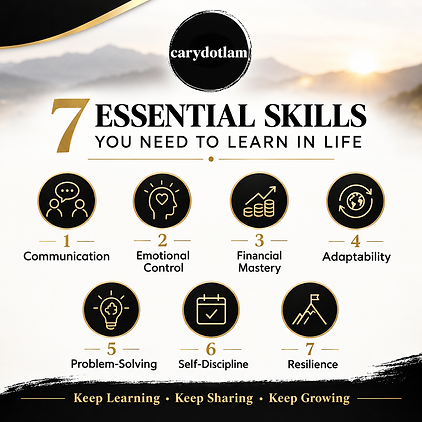
7 Essential Skills You Need to Learn in Life to Become a Better Version of Yourself
Life doesn't come with an instruction manual. But the skills you develop along the way can determine how well you navigate its challenges, build relationships, manage your finances, and achieve your goals.
We spend years in school learning academic subjects, preparing for exams, and earning qualifications. Yet, some of the most important skills we need in life are rarely taught in a classroom.
How do you communicate effectively? How do you manage your emotions? How do you make better financial decisions? And how do you bounce back when life doesn't go according to plan?
These are not just useful abilities. They are essential life skills that can influence our happiness, relationships, personal growth, and success.
The good news? You don't need to master them overnight. You simply need to be willing to learn, practise, and improve.
Here are seven essential skills worth developing at every stage of life.
1. Communication: Learn to Express Yourself and Understand Others
Communication is more than speaking. It is about expressing your thoughts clearly, listening with an open mind, and understanding what others are trying to tell you.
Many misunderstandings happen not because people cannot speak, but because they do not listen. We sometimes listen to respond rather than listen to understand.
Effective communication requires three important abilities:
Speak clearly: Express your thoughts, needs, and expectations honestly.
Listen actively: Give others your full attention instead of preparing your response while they are speaking.
Show empathy: Try to understand another person's perspective, even when you disagree.
Remember, you don't have to win every conversation. Sometimes, the most valuable outcome is a better understanding of each other.
Practical tip: Before responding during a difficult conversation, pause and ask yourself, "Am I trying to understand this person, or am I simply trying to prove that I'm right?"
Better communication can strengthen relationships, resolve conflicts, and open doors to opportunities.
2. Emotional Control: Master Your Reactions
You cannot control everything that happens to you, but you can learn to manage how you respond.
People will disappoint you. Plans will change. Criticism may hurt. Unexpected problems will arise.
If every difficult situation controls your emotions, you risk allowing external circumstances to dictate your internal peace.
Emotional control doesn't mean suppressing your feelings or pretending everything is fine. It means recognising your emotions without allowing them to make every decision for you.
For example, when someone makes you angry, you can react immediately and potentially make the situation worse. Alternatively, you can pause, breathe, reflect, and choose a more constructive response.
That small gap between a trigger and your reaction can make a significant difference.
Practical tip: When emotions run high, permit yourself to pause. Name what you are feeling, consider what triggered it, and decide how you want to respond.
You may not always control your first emotional response, but with practice, you can become better at choosing what happens next.
3. Financial Mastery: Make Money Work for You
Money isn't everything, but how you manage it can significantly affect your freedom, security, and quality of life.
Financial mastery isn't necessarily about becoming wealthy. It is about understanding your money, making informed decisions, and building habits that support your future.
Start by learning to:
Spend less than you earn whenever possible.
Understand where your money goes each month.
Build an emergency fund appropriate to your circumstances.
Manage debt responsibly.
Learn the basics of saving, investing, and long-term financial planning.
One common mistake is focusing entirely on earning more money without improving how we manage what we already have.
A higher income doesn't automatically create financial security if spending continually increases alongside it.
Practical tip: Review your income and expenses regularly. Identify one unnecessary expense, one opportunity to save, and one financial habit you can improve.
Small, consistent decisions can make a meaningful difference over time.
The objective isn't to impress others with what you own. It is to build a financial foundation that gives you more choices and fewer unnecessary worries.
4. Adaptability: Learn to Embrace Change
Life rarely follows the plan we originally imagined.
Careers change. Relationships evolve. Technology advances. Opportunities appear unexpectedly, while familiar circumstances sometimes disappear.
People who insist that everything must remain the same may struggle when life demands a different approach.
Adaptability is the ability to adjust your thinking, behaviour, and strategies when circumstances change.
It doesn't mean abandoning your values or changing direction every time something becomes difficult. It means remaining open to new information and being willing to adjust your methods when necessary.
Think about a goal you have been pursuing. If your current approach isn't working, does that mean your goal is impossible? Not necessarily. Perhaps you need a different strategy.
Practical tip: When faced with an unexpected change, ask yourself three questions:
1. What can I learn from this situation?
2. What is still within my control?
3. What can I do differently moving forward?
Change may be uncomfortable, but it can also create opportunities you would never have discovered otherwise.
Stay curious. Keep learning. Be willing to change your approach.
5. Problem-Solving: Focus on Solutions, Not Just Problems
Problems are an unavoidable part of life. What separates effective problem-solvers from those who remain stuck is often how they approach the situation.
When something goes wrong, it is easy to complain, blame others, or become overwhelmed by everything that could happen next.
However, spending too much time focusing on the problem can prevent us from identifying possible solutions.
Good problem-solving starts with understanding the real issue rather than simply reacting to its symptoms.
Break complicated challenges into smaller, manageable steps. Gather relevant information. Consider different options. Evaluate the possible consequences and take action.
You don't need to find the perfect solution immediately. Sometimes, the best approach is to try a reasonable option, assess the result, and make adjustments.
Practical tip: Whenever you encounter a problem, write down:
What exactly is the problem?
What might be causing it?
What possible solutions are available?
What is the first small step I can take?
Remember, not every problem can be solved immediately, and some circumstances are beyond your control. But you can often find a more constructive way to respond.
6. Self-Discipline: Do What Needs to Be Done
Motivation feels wonderful when it is present. Unfortunately, it doesn't always show up when we need it.
You may feel motivated to exercise on Monday but struggle to get started on Wednesday. You may feel excited about a new project but lose interest when progress becomes slow.
This is where self-discipline matters.
Self-discipline is the ability to follow through on important commitments even when you don't feel particularly motivated.
It helps you prioritise long-term benefits over immediate comfort.
However, discipline doesn't mean pushing yourself relentlessly or never resting. Sustainable discipline includes knowing when to work, when to recover, and how to maintain realistic expectations.
The secret is to make good habits easier to repeat.
Practical tip: Start small. Instead of promising to exercise for an hour every day, begin with 10 minutes. Instead of writing an entire article in one sitting, commit to writing one paragraph.
Small actions, repeated consistently, can build momentum and confidence.
You don't have to feel ready every time. Sometimes, you simply need to begin.
7. Resilience: Learn to Rise After Setbacks
Life will challenge you in ways you cannot always predict.
You may experience rejection, disappointment, failure, loss, or unexpected changes that leave you questioning yourself.
Resilience is the ability to recover, adapt, and continue moving forward after difficult experiences.
It doesn't mean you never feel hurt, discouraged, or afraid. It means you learn to work through those feelings without allowing a setback to define your entire future.
Failure can provide information. Rejection can redirect your efforts. Difficult experiences can reveal strengths, priorities, and lessons you might otherwise overlook.
But resilience isn't about enduring everything alone. Asking for help, taking a break, and allowing yourself time to recover are also signs of strength.
Practical tip: When something doesn't go as planned, ask yourself, "What can I learn from this, and what is my next best step?"
You cannot always choose what happens to you, but you can gradually develop the resources and support that help you navigate difficult times.
Remember, a setback is an event in your life. It doesn't have to become your identity.
Final Thoughts: Your Life Improves When You Improve Yourself
These seven skills have something important in common: they can all be developed through practice.
You don't need to become an excellent communicator, a financial expert, or an emotionally disciplined person overnight.
You simply need to recognise where you are today and identify where you would like to improve.
Start with one skill. Practise it consistently. Review your progress. Learn from your mistakes. Then move on to the next.
Personal development isn't about becoming perfect. It is about becoming more capable, more aware, and better prepared to handle whatever life brings.
You cannot control every circumstance, but you can invest in the skills that help you navigate them.
So, ask yourself:
Which of these seven skills would make the biggest difference in your life if you improved it today?
Don't just think about the answer. Take one small action.
Because knowledge gives you possibilities, but putting that knowledge into practice is what creates change.
Keep Learning! Keep Sharing! Keep Growing!
I hope you found this helpful! If you know someone who could benefit from this information, feel free to share it with them.
You can also explore more blogs across a variety of topics. To get started, click on the category linked below this post. Once you're on the main blog page, you'll find options at the top that allow you to browse through different categories and discover more content.
I’d truly appreciate hearing your thoughts—please leave your feedback in the comments section below!


Comments